Monday, 30 January 2012

Book review: Ground Control: Fear and Happiness in the Twenty First Century City

If you haven’t read it already I highly recommend Anna Minton’s book Ground Control: Fear and Happiness in the Twenty First Century City. Minton tracks the privatisation of public space over the last 30 years and considers some of the negative social consequences of this trend. She very cleverly ties together the model of development pioneered by the Thatcher Government in the 1980s with the development of Canary Wharf in London’s Dockland, firmly established by New Labour through Housing Market Renewal and continued by the current Coalition government with the Olympic park. All these developments are based on a model of regeneration that is dependent upon increased property values and have led to the erosion of public space in favour of privately managed streets and squares.  The streets maybe clean, but you can't protest in them, skateboard, tie up your bike or even take a photograph. The consequences of these developments are serious because as Minton says ‘who controls the roads and streets is enormously important to how cities function. Today there has been no public debate about selling off the streets at all.’

[image via Private Public Space]
The scary thing is that many of these regeneration projects have been made in the hope that wealth will trickle down to the poorest. The Docklands developments haven’t done much for the poor communities who live there. In fact, as Minton observes, Canary Wharf and the Excel centre are cut off from their surroundings and purposefully inaccessible on foot.  This rings true with my experience too. Quite recently I went on a tour of Newham’s most successful regeneration projects. I asked the council officer showing us round what benefits had been assured for the people living on the housing estate immediately adjacent to Excel. He just shrugged and said “they are hopeless.”

Sunday, 29 January 2012

Did Right to buy work for everyone?

Last October I went on a course in Participatory Appraisal.  Participatory Appraisal is a terrible name for a fantastic participatory research method based on a set of visual research tools that enable local people to identify, analyse and provide solutions to problems in their communities.  I was lucky enough to be working alongside a diverse group of Bangali, Somali, Uretran, Turkish and Spanish mums and dads from Tower Hamlets in East London. As part of the course we were sent off to collect people’s views on healthy living in the area. My group decided to go to the local health centre and we got talking with some older women who live in the area - Meg, Jean and June. Jean started to talk about the impact of the Thatcher Government's Right to buy scheme on her life. She bought her council house in 1980 when the scheme was first introduced. She felt that she had been duped into buying her council house and is now left with unsuitable accommodation on the second floor of a tower block with no lift. She can’t afford to pay for adaptations to her flat and she can’t deal with the stress and expense of moving. She, like many of her friends, just suffers on in unsuitable accommodation.

[Image of Margaret Thatcher and a Right to buy family in 1980 via The Guardian]
Although I had thought about the consequences of Right to buy for social tenants, in particular its impact on the quality and quantity of stock left in the sector, I hadn’t really considered the negative impacts of the scheme on homeowners who had bought their council homes through the scheme. In fact, like many others, I had assumed the scheme had been wholly positive for those households who were able to take advantage of it. This example highlights some of the downsides of Right to buy on those households who are now in their old age. If Jean had stayed in the social sector she would probably be able to move into more suitable accommodation or alternatively the council would have been obliged to make changes to her existing home.

Wednesday, 29 June 2011

Do we need to communicate more effectively?

I went to a really interesting conference last week that had been organised for PhD researchers who have, like me, been funded by a partner organisation outside of academia. The quality of the research presented was excellent. I got some great ideas about research design, theoretical incites were shared, and many of the findings would be extremely useful to practitioners and policy makers.

During one of the sessions an academic reflected on the fact that academic thought, and in particular social theory, just isn't valued by society at large. It got me thinking.  Is it enough to point to a failure outside of academia but not reflect on our own inability to communicate research effectively?

The conference was a case in point, this was a perfect opportunity to share academic research with funding partners, but no one from outside of the academy was invited. The funding supporting most of the research presented was designed to facilitate the linking up of academia and practice. I just wonder how seriously these partnerships are really taken? Do academics really want to engage beyond their collegues, students and peers? Or are we just following the latest funding streams, ticking the boxes and carrying on as usual? I'm not sure, I don't suppose I'm a position to judge, but I do wonder if we need to be better at communicating with the outside world.

Perhaps we need a Brian Cox for the social sciences - someone who can popularise social theory without dumming down. I wouldn't be able to sit down and understand a journal article about particle physics, so why should we expect others to engage with social theory on the same terms?

Thursday, 26 May 2011

Is home ownership the natural choice? Part 2

Yesterday I met up with my most sorted friend Katrin. Katrin is married, living in a lovely flat in Kew, with a really interesting and well paid job.  I had always assumed that she and her husband would follow the ‘natural’ next step and buy their own home in the next couple of years. Completely unprompted on my part (no really!) she started to question the pressure she was feeling to get onto the housing ladder.

She summed up the arguments pretty well:
  • Our obsession with owning a home in this country is just not normal
  • Buying a home isn’t necessarily a safe or sensible investment
  • There are benefits and downsides to owning a home and to renting that are different, not worse or better
  • At the moment they can afford somewhere bigger and better located if they rent rather than buy
  • They can save money if they continue to rent 
  • If they buy they will have to lock all of their equity up in the home
  • When they do buy it won't just be about a financial investment, but because they want to settle, re-orientate their lives to family or because its the perfect place for them in the right location.
From the outside Katrin seems like the perfect candidate to climb up on the housing ladder. The fact that she is rejecting it puts into question the idea that owning a home is necessarily desirable, even to those who could comfortably afford it. If other people feel the same way, and the tide turns away from home ownership as the default tenure type, do we need a different policy response?

    Tuesday, 24 May 2011

    Is home ownership the natural choice? Part 1

    Peter Saunders, in his book A Nation of Home Owners, argues that we, as human beings, have a natural disposition for 'territory and possession' that can only be fulfilled through home ownership.  There's no denying that the vast majority of people in the UK aspire to home ownership but I’m not convinced this comes down to some primordial urge. To present home ownership as the ‘natural’ order of things denies the fact the new dominance of home ownership has been shaped by policy moves to extend the tenure to the majority, while at the same time pulling back on social housing provision, and deregulating the private rented sector.

    The reason that most of us aspire to own a home, is not based on some natural urge, but on the fact that there isn’t much of an alternative. Home ownership is meant to be about ‘choice’ but there isn’t really much of a choice to be made when faced with rip-off landlords who charge high rates for shitty flats, and a social sector that isn’t large enough to provide homes to meet a general need.

    Who really wins in the aggressive extension of home ownership to everyone? If the recent crash is anything to go by not even the banks and certainly not the public purse or low income home owners. The assumed benefits of home ownership such as personal control and autonomy as well as wealth accumulation just don’t ring true when people are faced with the social, financial and personal costs of mortgage possessions and arrears.

    In my view, there is nothing inherent in the benefits and rights attached to home ownership, or any other tenure for that matter, because they are created in law and laws can be changed. I for one would happily stay in the private rented sector if I had some security of tenure, if I could ensure that a certain standard was maintained and if there were some controls over rents so I’m not priced out every year and forced to move on.

    Thursday, 28 April 2011

    Housing in Hard times

    I went to my first academic conference a couple of weeks ago at the Housing Studies Association Conference at York University. It was called Housing in Hard times: Class, poverty and social exclusion. The fact that class was actually in the title really excited me. Having worked on the equalities scheme and our inclusive design agenda at the Commission for Architecture and the Built Environment I quickly learned that class was almost impossible to talk about. It was like the elephant in the room while we talked about sexuality, race, gender and disability.

    The conference kicked off with Dr Gerry Mooney from the Open University, who talked about the language  of 'Broken Britain' used by the Coalition government, how it stigmatises working class people and borrows from the Victorian idea of the undeserving and deserving poor. The welfare state is presented as a failure, creating dependency, and instigating a ‘moral’ crisis in working class people. The solution is seen to be the pulling out of welfare provision, with what remains based on sanctions rather than help. I thought Gerry’s argument was really thought provoking, accessible and real. For me, he showed the need to constantly question the language of blame, while also developing the evidence to show how increasing inequality cannot be blamed solely on the individual but that there are broader social, economic and political forces that shape people’s lives.

    From this point onwards, I found the conference quite challenging (this is probably a good thing!) Discussions about class seemed to fall into academic language and theory that is useful but at the same time out of the reach of most people and - dare I say it - pretty elitist. I felt uncomfortable, partly because I couldn’t really engage in the argument, but also because I’m not sure what this type of academia actually does. It could be argued that it doesn’t have to do anything, academia doesn’t have to be about practice or change outside of the pursuit of knowledge within the university. However, the conference wasn’t just about academia, it was about influencing policy and practice too.

    Several academics called for action and there was some level of agreement that housing researchers have a responsibility to try and influence and change things. In fact some of the same academics who had written very theory heavy papers criticised Shelter for becoming part of the system. But there seems to be a bit of a contradiction here? Should housing academics really criticise organisations who are very active in tackling issues around good quality housing for everyone? And further, how far can this criticism be answered when it is turned back on academic researchers. Are we really that radical?

    The Golden Lane Estate

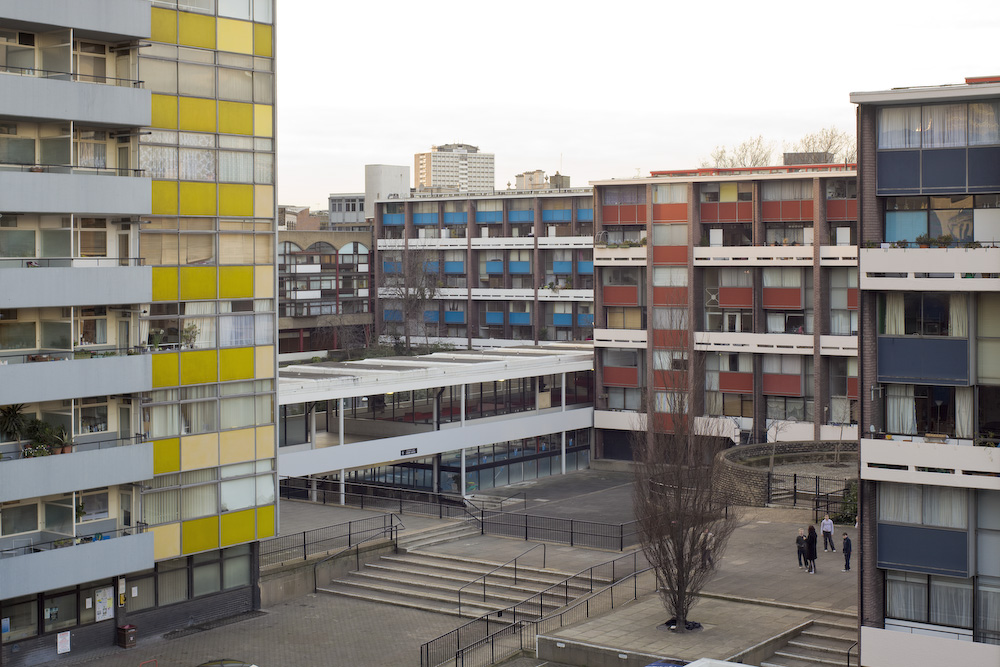
    I live here so I thought I should blog about it. The Golden Lane Estate was one of the first high rise social housing blocks in the UK. Built in the late 50s the estate was a precursor to the iconic modernist estate the Barbican which is located just next door, and was designed by the same architects Chamberlain Bon and Powell. Unlike the Barbican though, it was built to provide general need Council housing at affordable rents, rather than to affluent city workers. Many of the flats were sold off as part of the Right to Buy policy that began in the mid 1970s, but there continues to be a mix of council housing and private dwellings.


    [Image by Tim Crocker, via Walking City]


    The estate is the one of two council housing estates within the City of London, and makes up some of the 8000 people living within the City. It is sandwiched between one of the UK’s most deprived wards, the extremes of wealth in the Square Mile, and the media and arts centre that is Clerkenwell. In other words its a really interesting place that has seen a lot of change and continues to.

    One of the lovely things about living here is that unlike a lot of other places in London its actually really easy to get to know your neighbours. Its just a really friendly, welcoming place to live. Anyway, earlier this week, when we were down looking at the fish in the pond at the bottom of our tower block, we got talking to our neighbour and his 5 year old son. We live on the top floor so we invited them up to have a look at the view. We got talking about the estate and as a result he pointed us in the direction of a film on YouTube looking at the construction of Golden Lane Estate in the post-war period. Panoramic views from Great Arthur house show the extent of bomb damage suffered during the second world war. It also shows the optimism and belief in modernist architecture to offer good quality housing and a community life for its residents. Interestingly it still seems to work. I wonder why it continues to succeed while other housing estates of a similar era have failed?