Saturday, 7 July 2012

Book review: The Blackest Streets: The Life and Death of a Victorian Slum

I’ve been raving about Sarah Wise’s brilliant book The Blackest Streets so thought it was about time that I wrote a blog post about it. The book is a social history of Victorian London’s poorest and most notorious slum, the Nichol, a densely populated part of East London, tucked in between Shoreditch High Street and the western boundary of Bethnal Green. For me the brilliance of this book comes not just in the rich descriptions of the terrible material conditions of life in the slum (not least through the voices of the people who lived there, most notably Arthur Harding), nor in the exposure of the exploitation of the poorest by rich and often noble Victorian landlords, but in Wise’s critical (rather than unquestioning) perspective on often celebrated social scientists and reformers of the time.

[Charles Booth's poverty map of the Nichol via Wikipedia ]
 The book takes its name from Charles Booth’s poverty map of London which literally colour coded London streets based on a survey of the economic and moral condition of people who lived there. The Nichol was labelled ‘black’ because, as described on the legend on the map, people of the ‘lowest’ ‘vicious’ and ‘semi-criminal’ class lived there. Not to downplay the progressive social reforms that Booth contributed to, it is interesting to think about how his work very definitely fit into, and perhaps contributed to creating, categories of ‘deserving’ and ‘un-deserving poor’ which underlay social reforms at the time and arguably still do today. The poor were seen to have fallen down to the lowest level not because of socio-economic inequities or exploitation by scrupulous landlords, but because of their own failures. According to Wise, Booth and other social reformers, including the Reverent Osborne Jay of Holy Trinity church who lived and worked in the slum at the time, subscribed to the idea that poverty and deprivation could literally be ‘bred’ out of society through eugenics. This reading is a warning not to focus energy on the "moral failings" of a supposed underclass which comes to obscure more fundamental economic, social and political issues behind poverty and social inequality.

[Boundary Estate, copyright Rodney Burton via Geograph]
Such a perspective may lead to the clearance of poor quality housing but can also come to justify the forced clearance of people too. In the late 1800s the Nichol was cleared and replaced by the Boundary Estate, but many of the Nichol's residents were forced on and did not benefit from the new housing that was built in its place. Unfortunately this is an all too familiar story - the same can be said of some regeneration schemes that have happened over the last two decades, including the planned redevelopment of the Aylesbury Estate in South London as illustrated by Loretta Lees' work with residents there; and the demolition of homes in Kensington, Liverpool as shown by  Chris Allen’s study of Housing Market Renewal.

Friday, 4 May 2012

Byker Wall

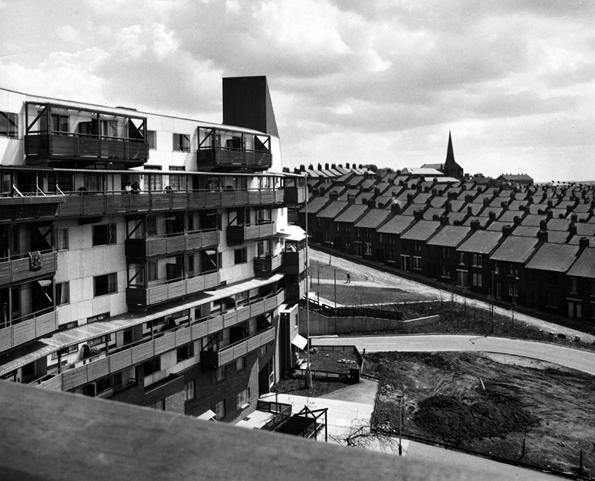
I was up in Newcastle earlier this week carrying out an interview for my PhD with a local housing association and was lucky enough to go on a tour around the Byker estate. The most famous and striking feature is the Byker Wall, a flatted block that snakes along 1.5 miles of the northern boundary of the site. Its huge, with entrances cut through to the housing and low rise blocks in the centre of the estate, sheltered by the wall. There is a vast array of housing types, painted in primary colours, as well as gardens, small public spaces and community facilities.  Although conceived in the late 1960’s the estate’s design is obviously a departure from the modernist tradition of Brutalist council housing that characterised the era.

[Map of the Byker estate via Great Buildings]
The original estate was built in the 1900’s to provide housing for people working in the ship building industries on the banks of the River Tyne. In 1967 the City Council made the decision to redevelop the area because of the poor condition of the housing stock. They appointed the architect Ralph Erskine to redesign the estate partly because of his approach to the redevelopment, which was based on respect for the social ties and community networks that already existed in the Byker neighbourhood.

  • The project was developed in 11 phases to allow for the rolling demolition and rebuilding of homes without the eviction of existing tenants
  • Dwellings were pre-allocated so that people could choose to stay with their neighbours
  • The design team opened an office on the estate and encouraged people to pop in and talk to them about the redevelopment and to ensure their specific requirements were met in the final design
  • Important social hubs like the pubs, the church and schools were retained.

As Lisanne Gibson and John Pendlebury argue in their book Valuing Historic Environments, [t]his was a step change from clearance elsewhere, where the focus was on housing as defective bricks and mortar rather than housing as home and a place of attachment.’

[Image of the Byker Wall via The Architects Journal]
With the decline in the ship building industry in the 1980’s came growing problems of unemployment in the Byker area. Since then the estate and its inhabitants have suffered with negative stereotyping due to a lack of maintenance, a growing number of void properties, as well as a high turnover of residents due to short leases. Things have improved in recent years and steps have been made to improve issues around community safety as well as external and internal improvements to the buildings structure.

Despite these ups and downs, residents still feel that ‘Byker is special.’ Old and new recall with pride that the community were involved in the process of redevelopment. This is interesting because it shows how the approach taken to redevelopment, based on a duty of care for the social as well as the physical infrastructure of the Byker community, lives on in collective memory.

Ralph Erskine on the Byker Estate, National Life Story Collection

Erskine, Ralph. (12 of 14). National Life Story Collection: Architects' Lives

Monday, 30 January 2012

Book review: Ground Control: Fear and Happiness in the Twenty First Century City

If you haven’t read it already I highly recommend Anna Minton’s book Ground Control: Fear and Happiness in the Twenty First Century City. Minton tracks the privatisation of public space over the last 30 years and considers some of the negative social consequences of this trend. She very cleverly ties together the model of development pioneered by the Thatcher Government in the 1980s with the development of Canary Wharf in London’s Dockland, firmly established by New Labour through Housing Market Renewal and continued by the current Coalition government with the Olympic park. All these developments are based on a model of regeneration that is dependent upon increased property values and have led to the erosion of public space in favour of privately managed streets and squares.  The streets maybe clean, but you can't protest in them, skateboard, tie up your bike or even take a photograph. The consequences of these developments are serious because as Minton says ‘who controls the roads and streets is enormously important to how cities function. Today there has been no public debate about selling off the streets at all.’

[image via Private Public Space]
The scary thing is that many of these regeneration projects have been made in the hope that wealth will trickle down to the poorest. The Docklands developments haven’t done much for the poor communities who live there. In fact, as Minton observes, Canary Wharf and the Excel centre are cut off from their surroundings and purposefully inaccessible on foot.  This rings true with my experience too. Quite recently I went on a tour of Newham’s most successful regeneration projects. I asked the council officer showing us round what benefits had been assured for the people living on the housing estate immediately adjacent to Excel. He just shrugged and said “they are hopeless.”

Sunday, 29 January 2012

Did Right to buy work for everyone?

Last October I went on a course in Participatory Appraisal.  Participatory Appraisal is a terrible name for a fantastic participatory research method based on a set of visual research tools that enable local people to identify, analyse and provide solutions to problems in their communities.  I was lucky enough to be working alongside a diverse group of Bangali, Somali, Uretran, Turkish and Spanish mums and dads from Tower Hamlets in East London. As part of the course we were sent off to collect people’s views on healthy living in the area. My group decided to go to the local health centre and we got talking with some older women who live in the area - Meg, Jean and June. Jean started to talk about the impact of the Thatcher Government's Right to buy scheme on her life. She bought her council house in 1980 when the scheme was first introduced. She felt that she had been duped into buying her council house and is now left with unsuitable accommodation on the second floor of a tower block with no lift. She can’t afford to pay for adaptations to her flat and she can’t deal with the stress and expense of moving. She, like many of her friends, just suffers on in unsuitable accommodation.

[Image of Margaret Thatcher and a Right to buy family in 1980 via The Guardian]
Although I had thought about the consequences of Right to buy for social tenants, in particular its impact on the quality and quantity of stock left in the sector, I hadn’t really considered the negative impacts of the scheme on homeowners who had bought their council homes through the scheme. In fact, like many others, I had assumed the scheme had been wholly positive for those households who were able to take advantage of it. This example highlights some of the downsides of Right to buy on those households who are now in their old age. If Jean had stayed in the social sector she would probably be able to move into more suitable accommodation or alternatively the council would have been obliged to make changes to her existing home.

Wednesday, 29 June 2011

Do we need to communicate more effectively?

I went to a really interesting conference last week that had been organised for PhD researchers who have, like me, been funded by a partner organisation outside of academia. The quality of the research presented was excellent. I got some great ideas about research design, theoretical incites were shared, and many of the findings would be extremely useful to practitioners and policy makers.

During one of the sessions an academic reflected on the fact that academic thought, and in particular social theory, just isn't valued by society at large. It got me thinking.  Is it enough to point to a failure outside of academia but not reflect on our own inability to communicate research effectively?

The conference was a case in point, this was a perfect opportunity to share academic research with funding partners, but no one from outside of the academy was invited. The funding supporting most of the research presented was designed to facilitate the linking up of academia and practice. I just wonder how seriously these partnerships are really taken? Do academics really want to engage beyond their collegues, students and peers? Or are we just following the latest funding streams, ticking the boxes and carrying on as usual? I'm not sure, I don't suppose I'm a position to judge, but I do wonder if we need to be better at communicating with the outside world.

Perhaps we need a Brian Cox for the social sciences - someone who can popularise social theory without dumming down. I wouldn't be able to sit down and understand a journal article about particle physics, so why should we expect others to engage with social theory on the same terms?

Thursday, 26 May 2011

Is home ownership the natural choice? Part 2

Yesterday I met up with my most sorted friend Katrin. Katrin is married, living in a lovely flat in Kew, with a really interesting and well paid job.  I had always assumed that she and her husband would follow the ‘natural’ next step and buy their own home in the next couple of years. Completely unprompted on my part (no really!) she started to question the pressure she was feeling to get onto the housing ladder.

She summed up the arguments pretty well:
  • Our obsession with owning a home in this country is just not normal
  • Buying a home isn’t necessarily a safe or sensible investment
  • There are benefits and downsides to owning a home and to renting that are different, not worse or better
  • At the moment they can afford somewhere bigger and better located if they rent rather than buy
  • They can save money if they continue to rent 
  • If they buy they will have to lock all of their equity up in the home
  • When they do buy it won't just be about a financial investment, but because they want to settle, re-orientate their lives to family or because its the perfect place for them in the right location.
From the outside Katrin seems like the perfect candidate to climb up on the housing ladder. The fact that she is rejecting it puts into question the idea that owning a home is necessarily desirable, even to those who could comfortably afford it. If other people feel the same way, and the tide turns away from home ownership as the default tenure type, do we need a different policy response?